Talking about Information Architecture — Jesse James Garrett and the 2009 IA Summit Plenary
Published Sep 28, 2026 • 4 minute read

By Austin Govella, digital strategist (and former information architect)
Since 1998, Austin has applied his information architecture skills for organizations big and small all across the globe. He co-authored Information Architecture: Blueprints for the web, 2nd edition with Christina Wodtke.
Summary: A first-person account of Jesse James Garret’s historically significant 2009 IA Summit closing plenary where he declared “there is no such thing as an information architect”, and a look at his argument about the need for a language for discussing information architecture.
I was in Memphis when it happened.
I was there.
All I ever wanted was to be an information architect.
We’d flown in from all parts for the annual sequester. It wasn’t a conference, yet. We still called it the summit.
You have to remember what it was like to be there, at the Information Architecture Summit in 2009. The economy had cratered. Layoffs, furloughs, hiring freezes, project shut downs, budget cuts, and canceled contracts: it’s tough to keep warm with a tattered economy.
But despite the throes of the financial crisis, we threw ourselves into the crowds at our annual crossroads.
We were optimistic.
Obama had won.
Obama signed a $787 billion dollar stimulus bill in February. One month later, banking on promises of a turbo-charged economy, information architects—and their hangers on—slid into the historic Peabody hotel in downtown Memphis.

The Peabody is ridiculously lavish. For a weekend, we ignored the economy and played fat cats with conference sessions and bar tabs. At one point, sunk low into lobby chairs, the bars closed, drinks gone, we drank two bottles of gin, straight from the bottle, because we had nothing more suitable to drink, nowhere more suitable to be, and nothing more pressing to wake for in the morning. It was decadent.
Now, the Peabody squats a few blocks from the Mississippi. All the buildings in that part of Memphis seem to squat down by the river. As we hopped the tourist perfect dive bars and juke joints of Beale street, not one of us noticed a dark figure mingling at the festivity’s edges.
As the last day wound down, pregnant with giddy afterglows, information architects gathered in the Grand Ballroom for the closing keynote. Jesse James Garret, this giant of a mind, a mensch of an information architect, lurched from the summit shadows and said:
“There are no information architects. There are no interaction designers. There are only, and only ever have been, user experience designers.”
He continued:
“there is no such thing as an information architect”
***
I know what you’re thinking, but shit-posting wasn’t a thing, yet. Twitter was only three years old, and everyone still lived on LiveJournal. This was before the Russians took over.
You have to believe me: Garret’s statement was a big deal. Seven years previous, his essay, “ia/recon”, built a world where big and little IA lived together. His visual vocabulary? The very boxes and arrows we used to draft our blueprints, and his diagram, the Elements of User Experience, had positioned information architecture as a core design discipline for a decade.
All I ever wanted was to be an information architect.
But Garrett was serious. Information architecture wasn't dead. It had never been.
There were no slides. There was no stage. There was no spotlight. For 43 minutes, Jesse paced up and down the Grand Ballrooms’s center aisle reading his talk from his phone.
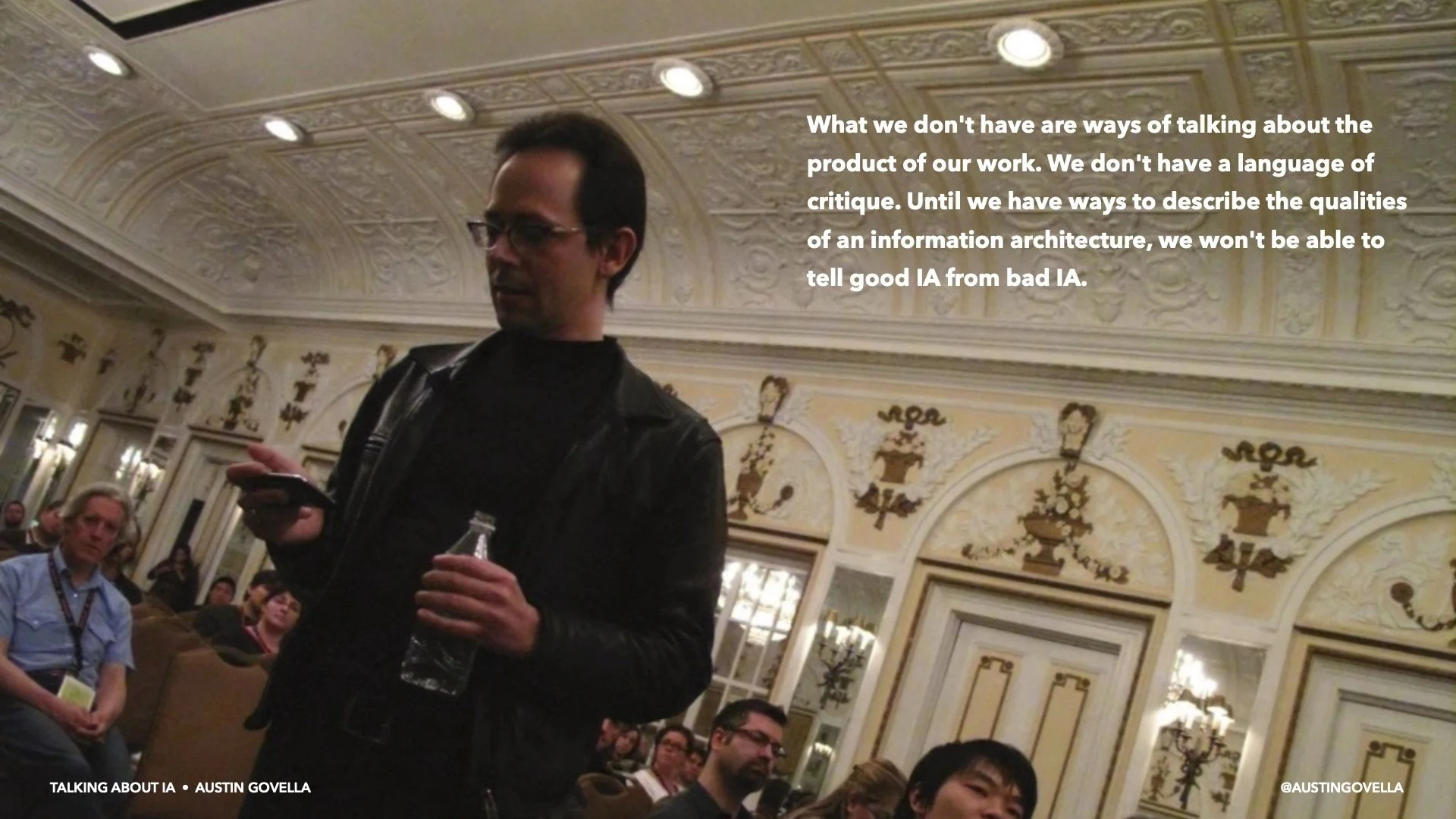
And for the last 10 years, for a decade, those 43 minutes haunted my mind. It wasn’t the salvo at the title. It was what he said about what we say. It was what he said about our language.
“What we don't have are ways of talking about the product of our work. We don't have a language of critique. Until we have ways to describe the qualities of an information architecture, we won't be able to tell good IA from bad IA.”
Since striking that chord, our colleagues have danced about information architecture, choreographed careful languages of critique. In most cases, they combine words to talk about IA with ideas on how to judge what’s good or bad. I believe that takes a bad turn. The language we use should describe information architecture, not prescribe what is good or bad.
Over the next essays, we’ll learn three ways to talk about information architecture:
We’ll work through ways to distinguish the scale of an information architecture.
We’ll find language that describes how people experience information architecture.
We’ll explore ways to describe the differences between information architectures.
Our examples will emerge from the commonplace:
an ecommerce website
an intranet
a coffee shop
a church
a walk on the beach.
The point is to have clear, objective, shared ways to compare and contrast information architecture. We want to discuss, debate, and measure how good an IA is or predict how good it should be.
We want a shared language we can use to talk about the many different ways you can get to good.
But first, let’s talk about what makes good language, so can make sure we have.