Six attributes describe experience
Published October 1, 2026 • 12 minute read

By Austin Govella, digital strategist (and former information architect)
Since 1998, Austin has applied his information architecture skills for organizations big and small all across the globe. He co-authored Information Architecture: Blueprints for the web, 2nd edition with Christina Wodtke.
Key takeaways: Six attributes let you describe any experience without judging the experience good or bad: Four primary attributes (Understand, Access, Control, Monitor) and two secondary attributes (Relevant, Adaptable). Examples compare music stores, churches, and AI to show how information architecture shapes experience. Austin Govella proposes the six attributes as a neutral vocabulary for information architecture critique.
My whole life, any time I need a little peace, a little solace, I take the highway down the Texas coast into a little town called Aransas Pass, take a left at the HEB and drive down to the ferry landing. From there, it’s a quick ride across the channel to the north end of Padre Island, to the cozy, coastal town of Port Aransas.
A short drive down the access road, and I’ve arrived at the beach.

I’ve often wondered why I find this place so peaceful. This is where my parents lived when I was born. Do I sense some residual experience of waves and wind from my mother’s womb? Or is it an amalgam of years of memories of friends and family and former lovers. I’m not sure, but when I need peace, this is where I go. This is where I’m one with the universe. This where I come to touch the divine. This is my church.
This is a sacred grove in the Sahel in Ghana. People come here to touch the divine. I didn’t know this, but cultures in every country in the world have kept sacred groves, places where they go to be close to their gods. This is a church.

This church is probably more familiar. It’s the Mt. Zion church in Manhattan. This looks like a church. You have the crucifix perched atop the pitched roof, and look at the three stained glass windows above the door. Each is topped with an arch, and the central window is more prominent than the other two.

This is a church in Denver. It looks a lot like the one in Manhattan. Pitched roof. A crucifix perched atop. It even has the same three stained glass windows topped with arches, although in this example, the central widow is much more prominent than the one in the Mt. Zion church in Manhattan.
But this isn’t a church.
This is a nightclub.

This is the Eleven22 church in Jacksonville, Florida. Other than the crucifix, it looks totally different. No pitched roof, and no three stained glass windows.

The Eleven22 church is inside what was once an HH Gregg appliance store.
What architecture makes this old appliance store a church?
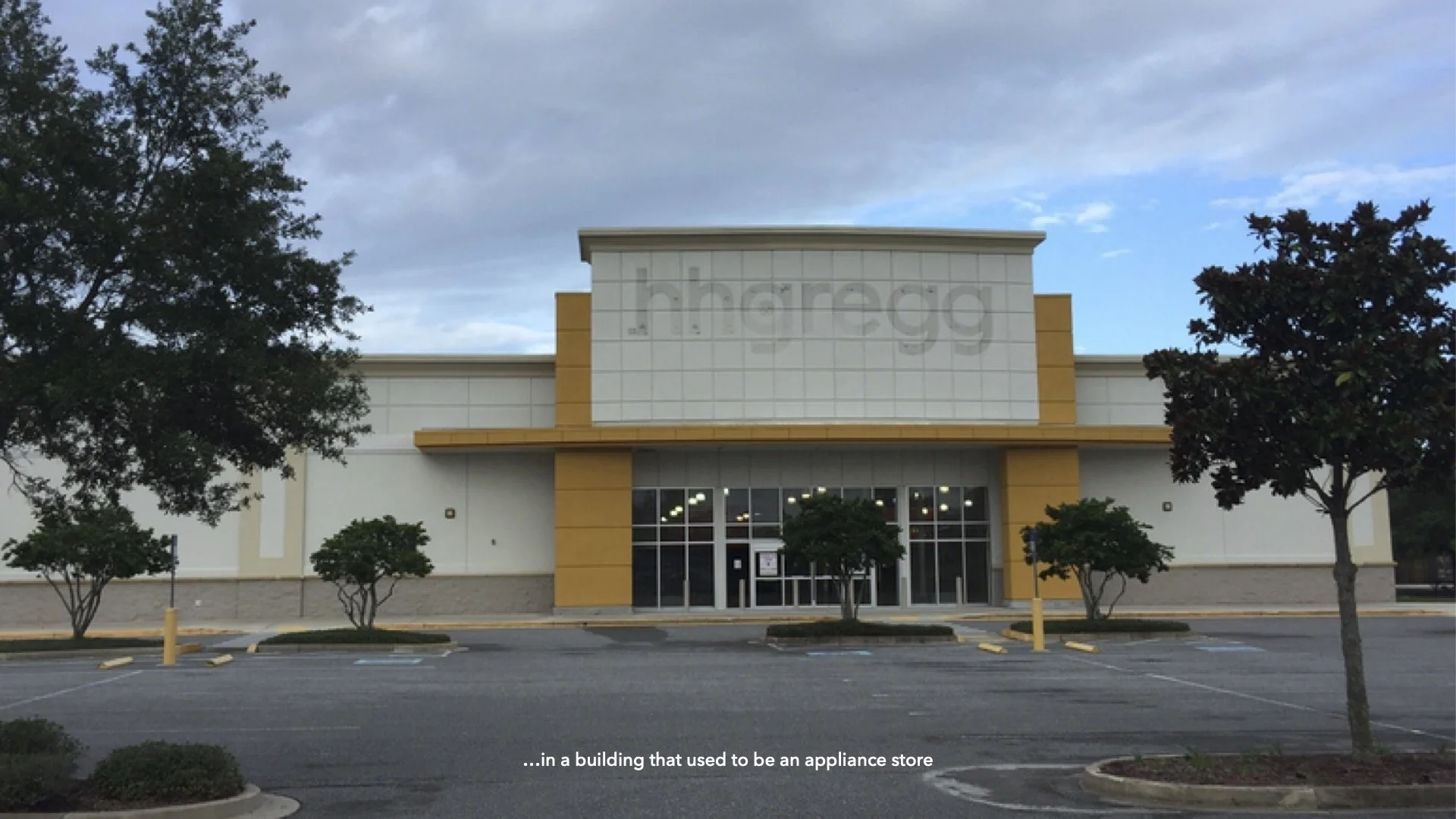
Where’s the architecture?
When I visit the beach at Port Aransas, what makes this my church?
Where is the architecture?

***
Philip Johnson is my favorite architect. I don’t really know that much about other architects, but I know a lot about him. For years, late at night, I would randomly turn on public television, and there would be Charlie Rose interviewing the very elderly Philip Johnson in his perfectly round eye glasses and wry smile.
Later in life, Johnson explored sculpture, and Rose asked if sculpture and architecture were similar.
“No,” chuckled Johnson. And he had this way of tossing an idea away, almost dismissing it: “They’re completely different.
“Art is something you experience. Architecture is where you experience it.”
Architecture is the place where the experience occurs. It’s not a structure. Where, indeed, is the architecture?
Where is the architect?
In 2019, Carmen Maria Machado released In the Dreamhouse, a memoir about her coming out and her first real relationship, a caustic, toxic, abusive affair.
She and her girlfriend share a house—their dream house—and she uses the house as a conceit to explore all the different possible perspectives of their relationship, to look at all the tropes.
The dreamhouse as memory palace, as lesbian cult classic, as stranger comes to town, as romance novel, as bildungsroman, coming of age story...
Her point about the house, and about one’s life in general, is that you give the room its purpose. It doesn’t matter what was intended, the person inside is who determines if the story is a romance, comedy, tragedy, thriller, or horror story.
“The inhabitant gives the room its purpose. Your actions are mightier than any architect’s intentions.”
Where, indeed, is the architect?
Let’s talk about experience
It is impossible to talk about architecture without also talking about experience. Experience is the architects intent, the space’s effect, and the visitor’s phenomenon.
As information architects, we create semantic, information environments to increase the chances our visitors will have certain types of experiences over others. So, it follows, if we want to have a disciplined, systematic study of information architecture we should be able to identify, discuss, and evaluate the kinds of experience we generate.
Our pursuit of good critical language continues.
As we talk about experience, we want to make sure we remain neutral, and don’t try to classify good or bad experiences. We want to make sure we can be agnostic of when, where, or how the experience occurs. And we want to focus on the outcomes of the experience, what happens, not what drives the experience happens afterwards.
So that sets some ground rules for this discussion. Let’s go a little further and make sure we’re set up for success.
I want to draw a very limited frame around “experience”. This more marks the borders of my thinking than where one needs to stop. For me, it starts getting fuzzy outside of these bounds, so I want to stay inside where it’s safe, for now.
I don’t want to spend time on how the user learns of the experience or how they find it. Not that those aren’t useful questions. I just don’t want to discuss them here. Likewise, I don’t want to talk about what happens after. Is it connected to another experience? Where does one experience stop and another one begins? Again, good questions. Just not for me right now.

In a similar fashion, I want to avoid channels for now. They’re important, but I think we can get to a holistic description of experience without them.

Six attributes describe experience
Let’s start with the mnemonic:
Head
Feet
Hands
Eyes
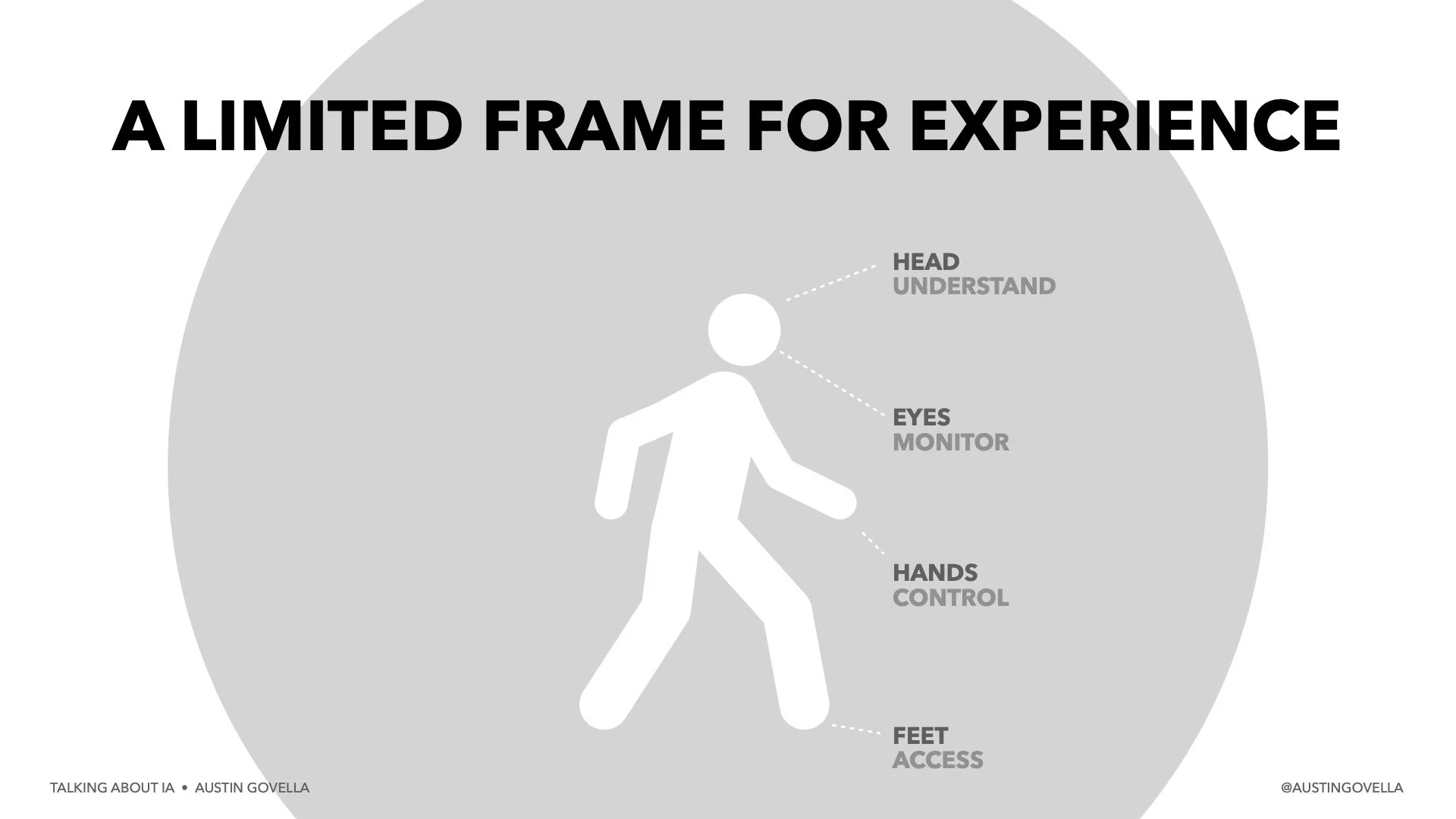
For the head, does the user understand the experience?
For the feet, can the user access the experience?
The hands represent whether or not the user can control their movement through the experience.
Eyes refer to how well the user can monitor their process through the experience.
Two complimentary attributes of experience. The first is relevance. How specific and relevant is the experience to the user. Think of relevance as a conceptual ball that is closer or farther away from the user.
Adaptable refers to how well the user can or can’t adjust the experience to make it more relevant to them.
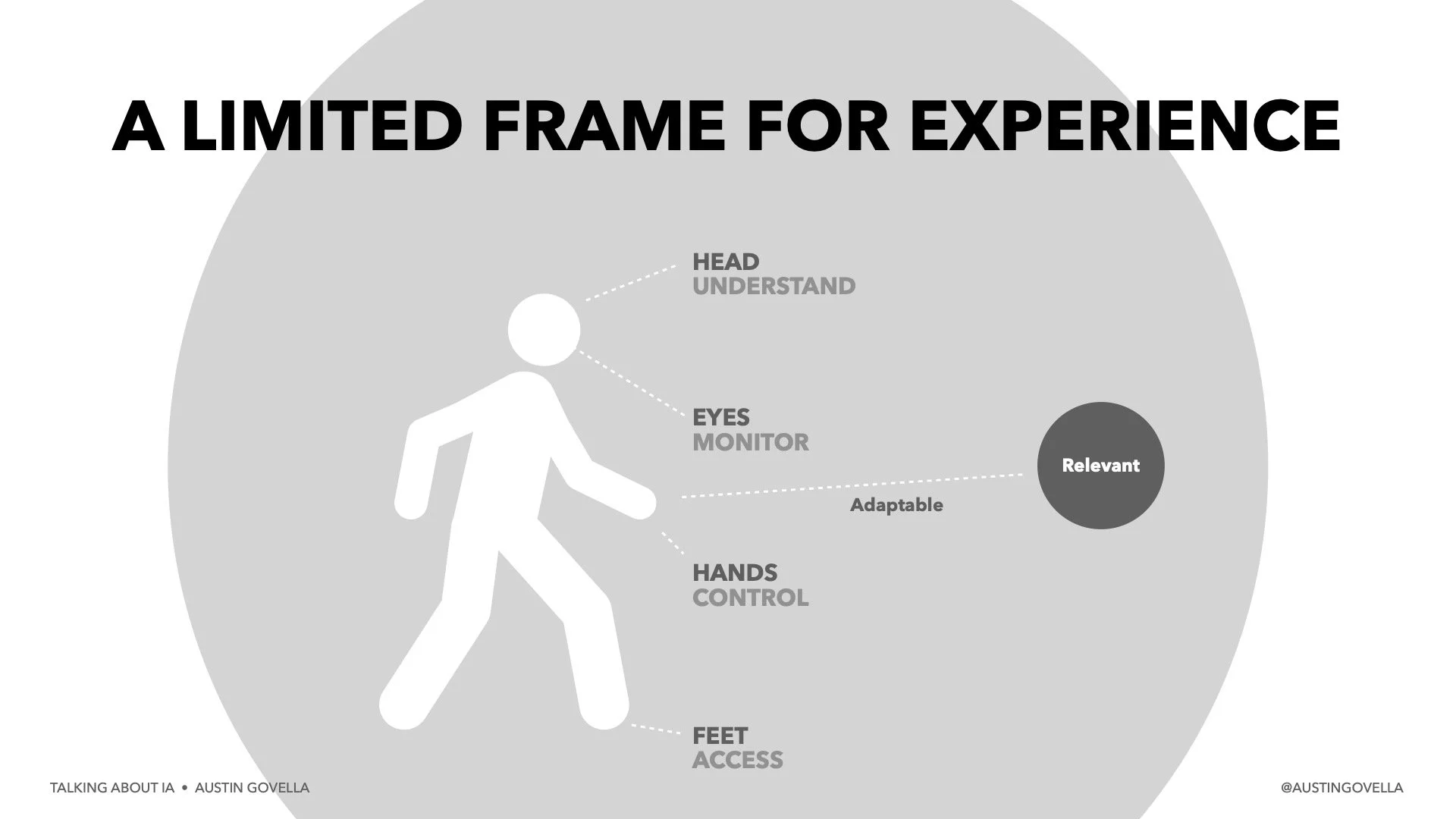
So that’s a current attempt at a mnemonic: head, feet, hands, eyes. Plus the complimentary attributes, that gives us six, objective properties we can use to discuss experience.
We have four primary attributes:
Understand - does the user comprehend the experience
Access - can the user participate in the experience
Control - can the user govern how they move through the experience,
And Monitor - can the user observe where they are in the experience
All four provide a way for us to differentiate one experience from another. In keeping with our goals, these attributes are both neutral and agnostic, we can use them to describe any kind of experience.
The two secondary attributes continue this approach:
Relevant - how specific is the experience to the user, and
Adaptable - can the user adjust the experience to make it more relevant
Let’s do a quick dive into each attribute of experience, before we look at how to use this vocabulary.
Understand
Understand, how well does the user understand the experience. On the left, at the low end of understanding, we have the inscrutable, affordance-free monolith from the movie 2001 A Space Odyssey. On the right we have a big red button. I don’t know what to do with the monolith. I understand I can push the button.

This is similar to the idea of affordance, but let’s leave that aside for a moment.
In Everyware, Adam Greenfield describes a similar concept of legibility:
“What sorts of features support [the user’s] attempts to figure out where they are, which paths connect them to a given destination, and how best to actually go about going there.”
Access
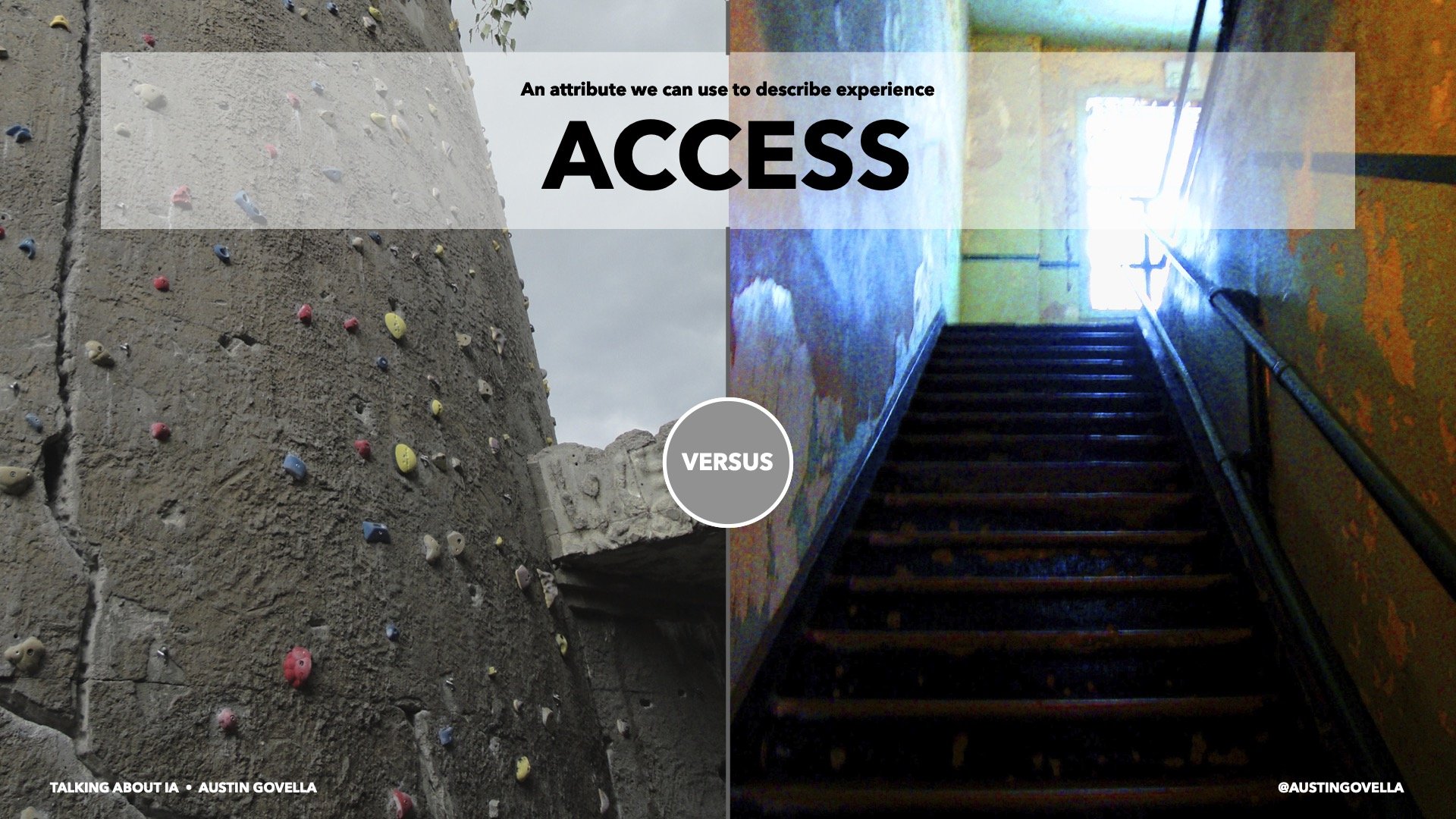
Access is another way to think about experience. How able am I to participate in the experience. If I want to go up, the stairs are more accessible to me than the climbing wall. It’s easier for me to use the stairs. Imagine what access would mean if I was in a wheelchair.
Control
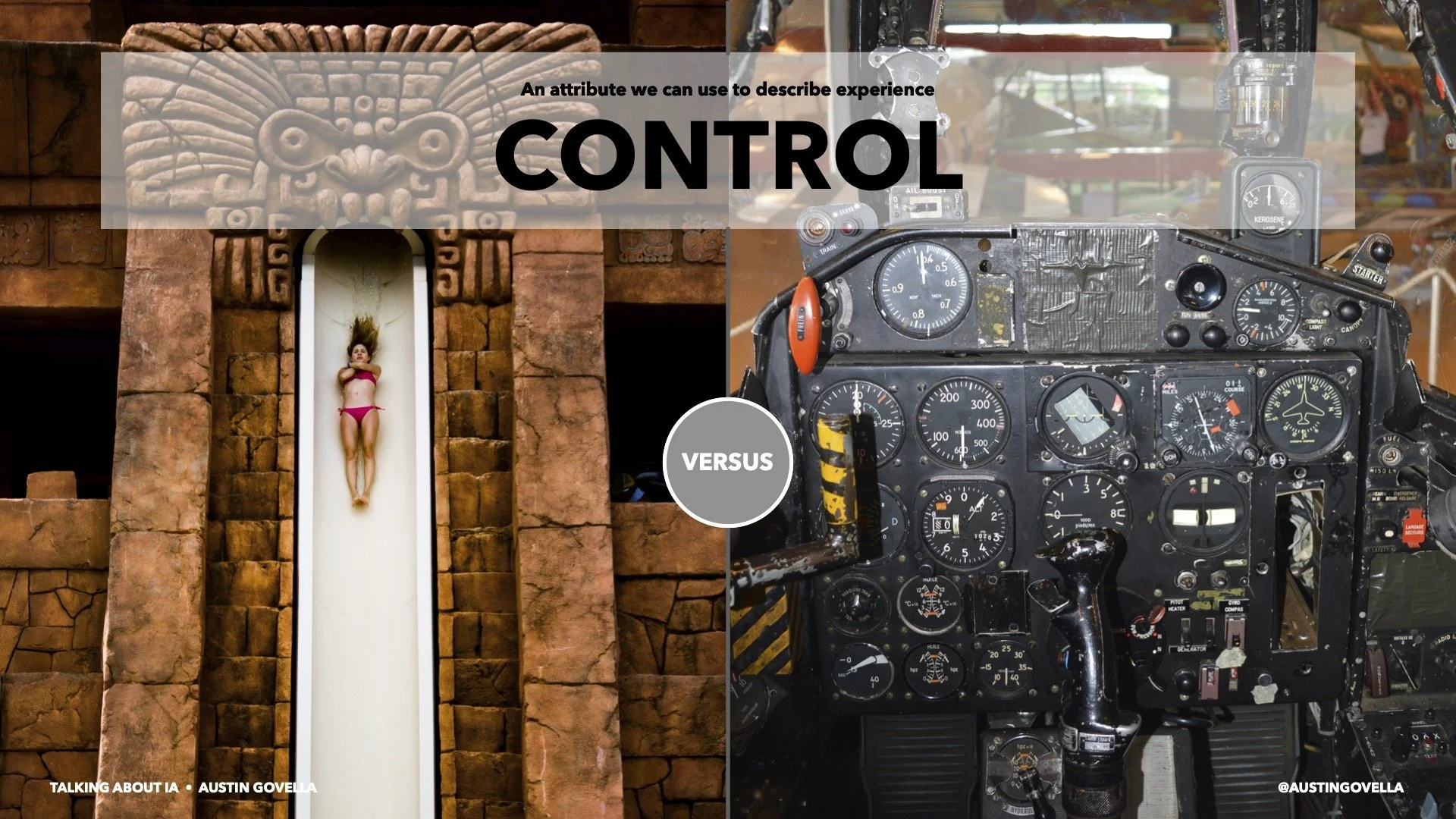
Control has to do with how much you’re able to control your movement through the experience. Water slides give you no control. You go over the edge and then just go where you’re taken. In contrast, an airplane cockpit gives the pilot lots of control.
Monitor
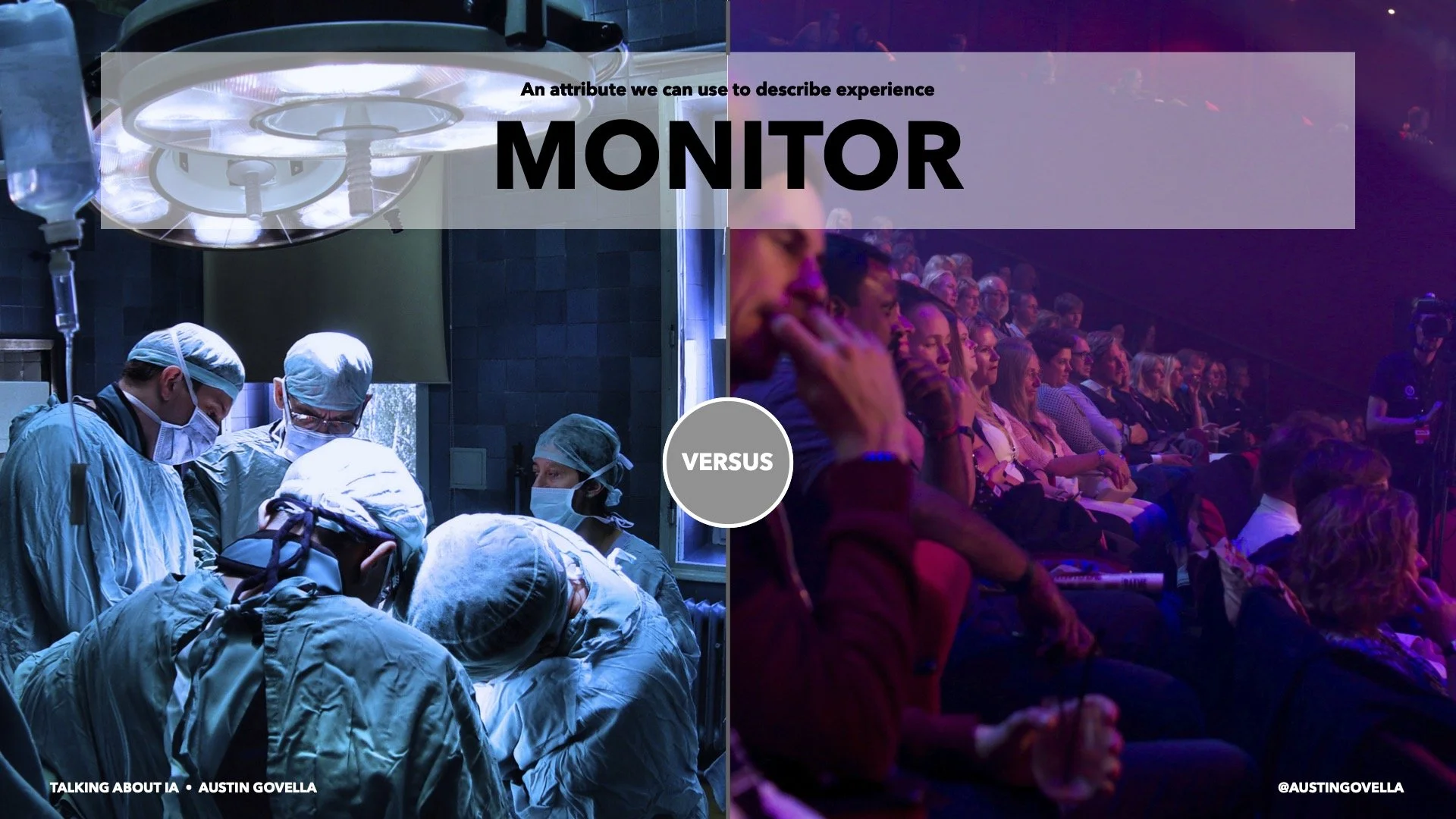
Monitor describes how well the user can monitor the experience. In surgery, you can’t monitor anything. They knock you out. In contrast, in an audience, the entire experience depends on your ability to monitor.
Relevant
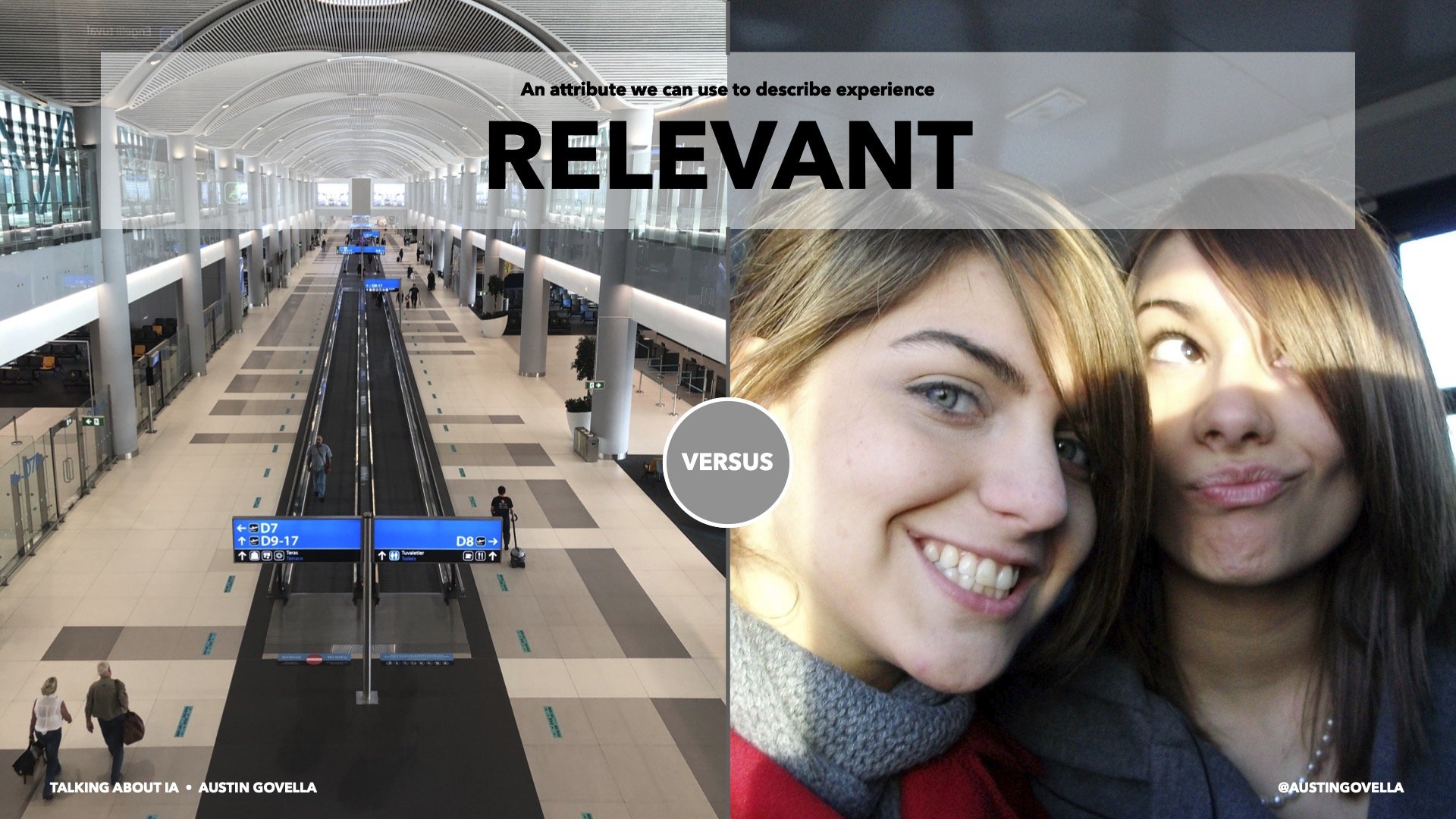
Relevance has to do with how personal you find the experience. Imagine an announcement in an airport terminal. That announcement is much less relevant to you than an announcement from a friend.
Adaptable
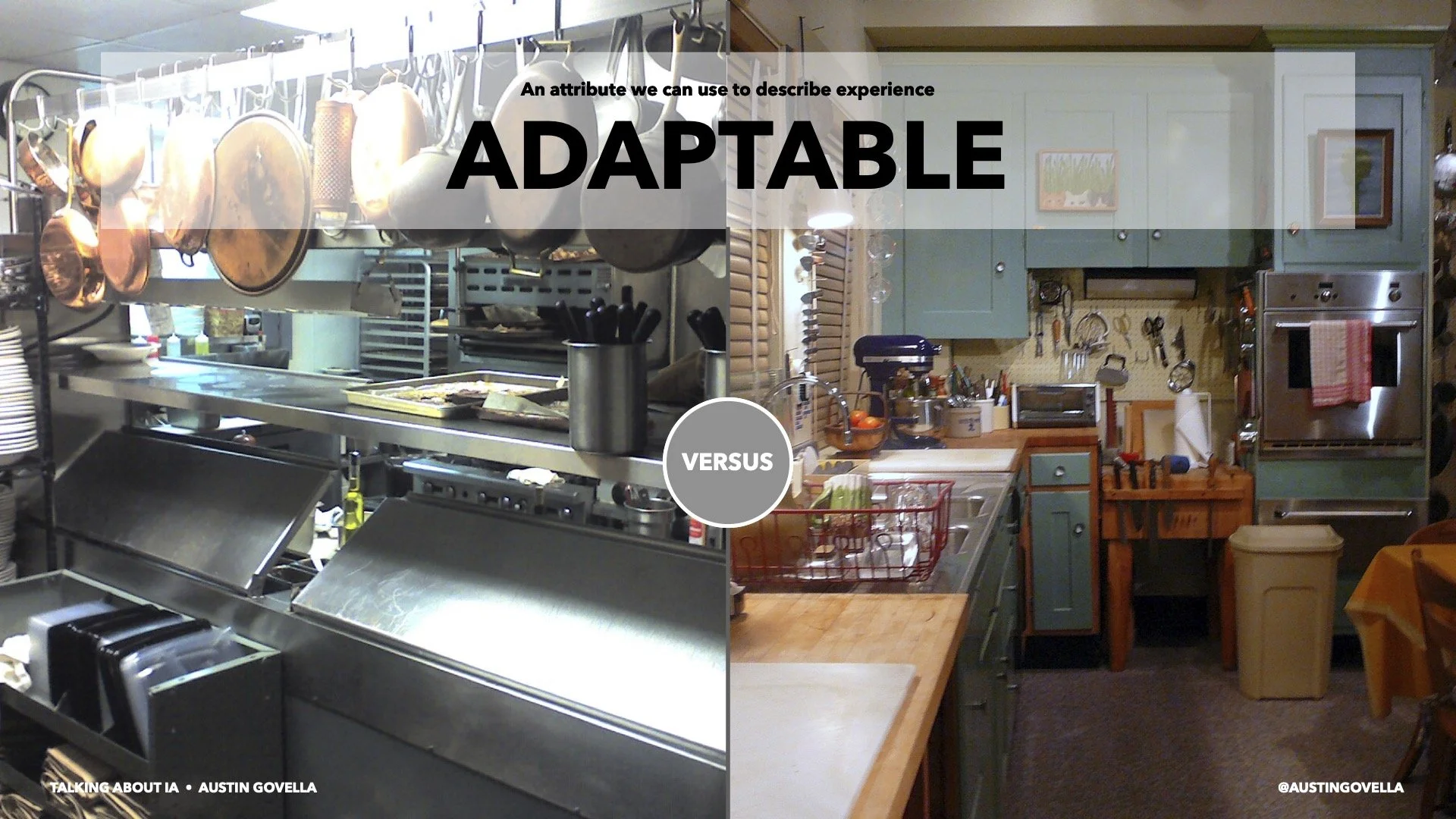
Adaptable describes how possible it is for the user to adjust the experience to make it more or less relevant. At one end, you have the kitchen at the restaurant you visit for dinner. You can’t change anything about the kitchen. At the other end of the spectrum, you have your kitchen at home where you have adjusted exactly where everything is.
Describing experiences with the six attributes
Example: Buying music
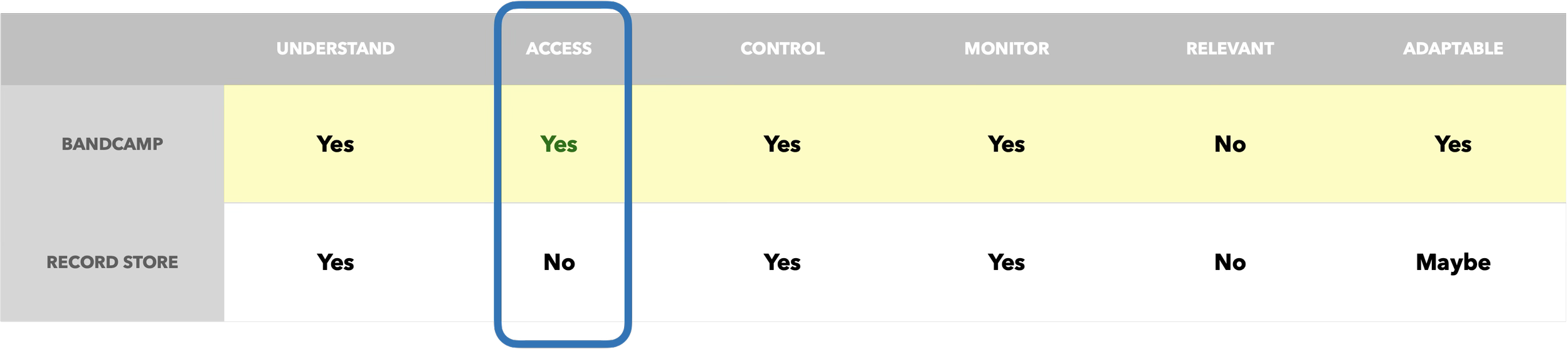
I like to buy music. I love lingering over vinyl bins fingering the records looking for special finds. However, nowadays, I buy most of my music on Bandcamp, as website that allows bands to sell their music directly to customers.
Between Bandcamp and the record store, you can see that the experience of buying music—how understandable, controllable, monitorable, and how relevant—is about the same.
However, access is very different. I can access Bandcamp any time I want. I never have time to drive 30-minutes into town to loiter around record racks for an hour and then drive another 30-minutes home. I have kids. I never have two hours for anything.
Importantly, note that we’ve made no judgement about which experience is better. We’ve only noted a way they are different. And we’ve noted the differences in experiences that occur at vastly different touchpoints.
***
So, it seems like I buy more from online vendors. What if we compare Bandcamp to other online music stores like iTunes and Beatport. I rarely buy music from iTunes and Beatport.
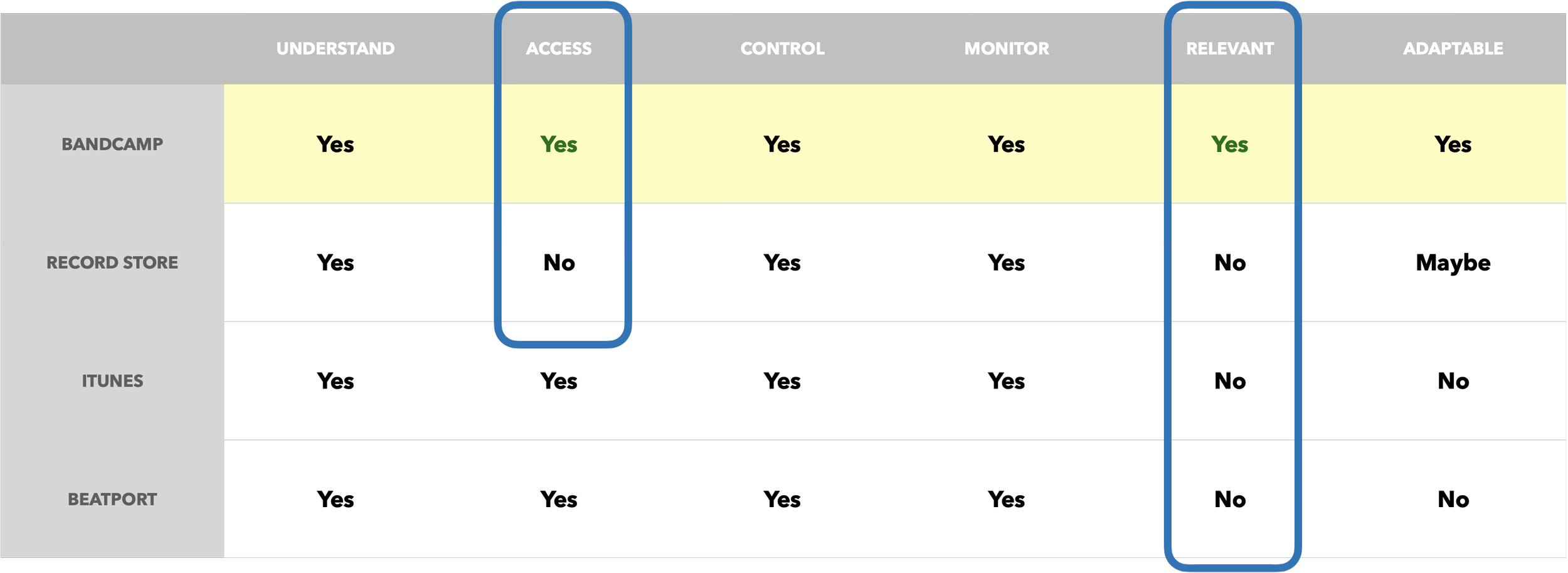
Turns out their selections are much less relevant to me than the music I can find on Bandcamp. So, I patronize Bandcamp more.
Again, we’re not making any judgements about what experience is good or bad. We’re just comparing the types of experiences I have. We’re comparing the experiences that different information architectures have enabled.
Now, you might one wondering about the “adaptable” column on the far right. Ignore that. I don’t think I have all the kinks worked out. That’s ok, because I hope you see this as an opening for discussion, rather than a grand, unassailable theory.
And, anyway, evaluating shopping experience is easy. What about touching God?
Example: Touching the divine
In this example, I’ve taken a swag at how I would evaluate my experience touching the divine at our various churches. You can see the experiences are a bit more varied. For example, I better understand how a built church would get me closer to God than the natural setting.
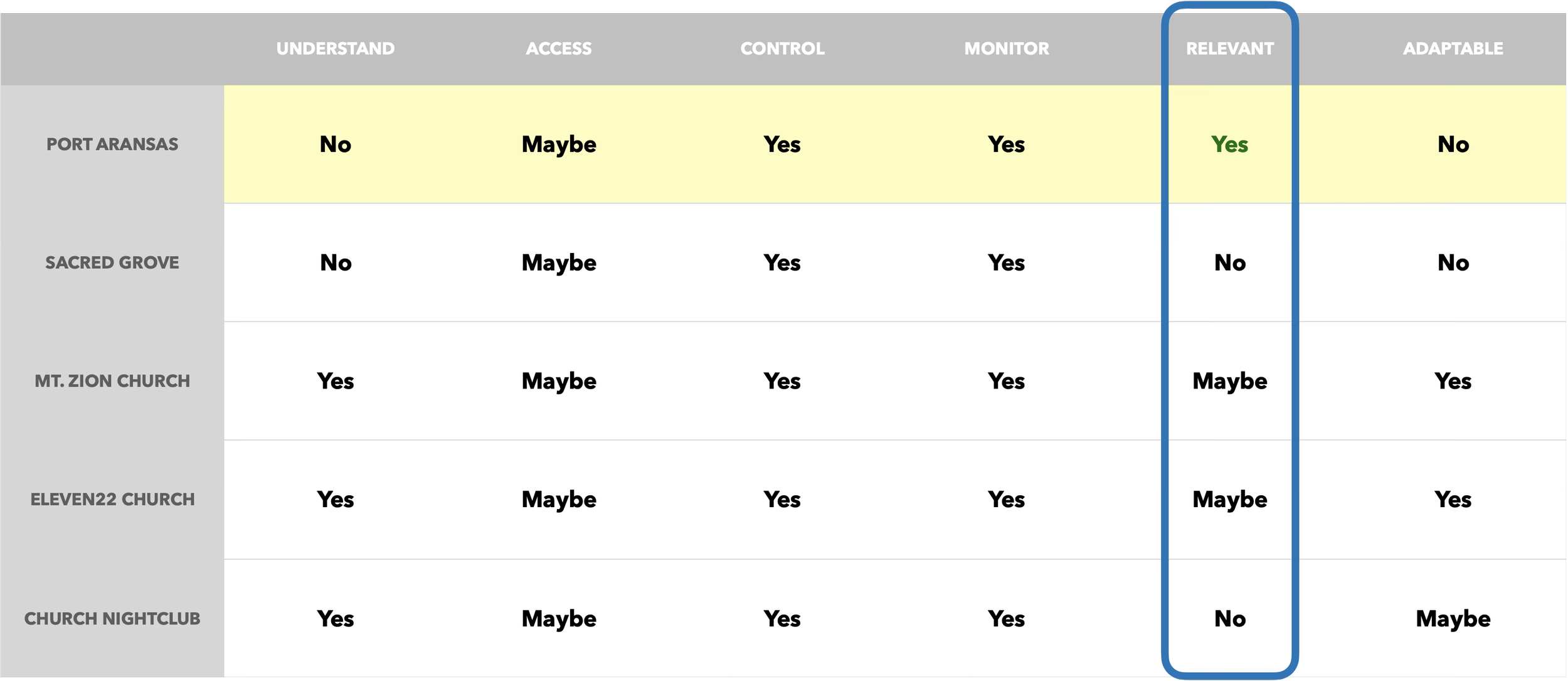
However, my preference is for the one that’s more relevant to me, Port Aransas.
Here, the adaptability column is interesting. I feel like I have a greater ability to adapt my experience in the built churches than I do in the natural ones.
Let’s zoom out to something more macro, like the ethics of artificial intelligence.
Example: Ethics of A.I.
There’s a lot of hand-wringing and fretting about artificial intelligence, biased algorithms, and how we can design better AIs.
Perhaps our concern with artificial intelligence is not how ethical it is, or how to make an A.I. ethical.
Perhaps our concern is that: we have no way to know how ethical a given A.I. will be.

A.I. is a black box by design:
We don’t understand how much control we have over a given interaction with artificial intelligence.
We have no way to monitor the algorithms that drive the A.I.’s decisions, and
We have no way to know how well we can adapt our experience with an A.I. to make it more or less relevant to our needs.
Is it any wonder AI bothers us when we think about it?
Here’s a thought experiment: think of another experience with a similar profile where you have no control, cannot monitor, and can’t adapt it to improve the relevance. Can you think of one that’s a positive experience? I bet you can.
***
As these examples show, we can describe experiences in ways beyond good and bad. We can describe information architecture by the type of experience it generates.
Understand – does the user comprehend the experience
Access – can the user participate
Control – can the user govern how they move through the experience
Monitor – can the user observe where they are in the experience
Relevant – how relevant is the experience
Adaptable – can the user adjust the experience to make it more relevant
We can look at how good and bad experiences compare based on these attributes. We can develop ideas about when it is and isn’t good to reduce the user’s ability to monitor an experience, or the best way to improve monitoring for a given channel or medium.
When we can describe the type of experience an I.A. engenders, we have a way to evaluate how the qualities of an experience affect whether we judge it to be good to bad.