Information architecture works at different scales
Published September 29, 2026 • 7 minute read

By Austin Govella, digital strategist (and former information architect)
Since 1998, Austin has applied his information architecture skills for organizations big and small all across the globe. He co-authored Information Architecture: Blueprints for the web, 2nd edition with Christina Wodtke.
Key takeaway: To evaluate an information architecture, first identify at what scale it operates. Information architecture generally applies to one of five scales: The organization, The platform, The site, The interface, or The interaction. At each scale, information architecture operates with different constraints. Each scale changes at different rates, and each scale operates within a different design context. Scale gives us a way to classify the type of information architecture, so we know what we can compare. Platform to platform and site to site.
5 years ago, I was called in to help a global energy company migrate from their digital marketing sites from one platform to another.
It was one of those swanky consulting gigs. Posh hotels, exciting restaurants, trips to key cities around the world…
Their current platform had been discontinued and vendor support was due to shut down. They needed to move to a living, supported platform.
So we interviewed stakeholders. We talked to seven, separate lines of business and discovered they didn’t just have a vendor support problem. They had a platform problem. The current platform was slow to update and make changes, so they never tried anything new. The current platform provided only basic analytics, so marketing teams weren’t sure what worked, and it was slow and expensive to launch new sites.
We didn’t just move them to a new platform. We transformed how they went to market with a new, customized digital marketing platform. From the original seven sites, the platform has since launched 100s of websites across 12 different business lines in over 9 languages in countries all over the globe. Time for updates went from weeks to days, so content and campaigns are always up-to-date. Time to launch new content went from months to weeks, and the time to launch new sites went from years to months. In addition, the cost to launch a site went down 66%, organic traffic was up for most business lines by 20% Year over Year, lead generation up as much as 150%, and analytics are built into every component, so the marketing team now has detailed data on how content, personalization, and campaigns perform. Of all the things I’ve ever worked on, this is one of my greatest designs.
And it looks like this.

We delivered a platform. Not a site. We delivered a platform the client could use to build sites. We did some wireframes, but they were conceptual to show what could be done and weren’t used to design individual sites. We created no site taxonomies, did no content audits. We delivered no templates.
But the IA we created gave the client and its vendors the language and mental models they needed to build their sites. Instead of taxonomies, we gave them metadata and classification systems. Instead of templates, we gave them layouts and components, so they could design and build their own pages.
***
Now, there’s an old mental model floating around that likens IA and other design pursuits to creating blueprints before you build the house.
This was true 15 years ago when there were no platforms or useful, off-the-shelf software for building sites. Nowadays, it’s more like interior design. Someone else has already laid the slab and built the walls. You already have the platform. You come in, hoping it has good bones, and make it somewhere livable.
Nowadays, I.A. is more Fixer Upper than Frank Gehry.
Most times, you don’t design the best taxonomy, you design what the platform will allow. You don’t leverage the metadata you need, you use the fields the platform makes available.
So, sometimes IA works at the platform level,…

and sometimes IA works at the site level. At each level, you do the same kinds of activities with different types of inputs and outputs.

If we continue our fantastic journey, our scale grows narrower because sites are made up of interfaces.

Just like with platforms and sites, to architect good interfaces, we must understand the mental models, their pieces, and how they should be joined.
Just as platforms are places where sites occur, and sites are places where interfaces occur, interfaces are places where interactions occur.

To architect one level, you need to understand the foundation it creates for other scales. For example, to architect the platform for the oil giant, I had to understand what kinds of sites they wanted to build. To understand those sites, I needed to understand the types of interfaces they might want to design. To architect those interfaces, you need to understand the type of interactions they want to enable.
The information architecture at the larger scale constrains the architecture at the smaller scale. As John Culkin wrote:
“We shape our tools and then the tools shape us.”
For the oil giant, I shaped the platform, and then the platform constrained what type of sites could be built.
These constraints ripple across all scales. The sites suggest possible interfaces. Possible interfaces allow possible interactions. The shape of the tool echoes through what the tool helps you build.
You hear the echoes elsewhere as well. One of my favorite quotes comes from architect, Eliel Saarinen:
“Always design a thing by considering it in its next larger context – a chair in a room, a room in a house…”
Because I understood the sites the client needed to build, I was able to design the platform.
As an aside, these two quotes illustrates design’s fundamental tension: context drives the design and the design creates the context.
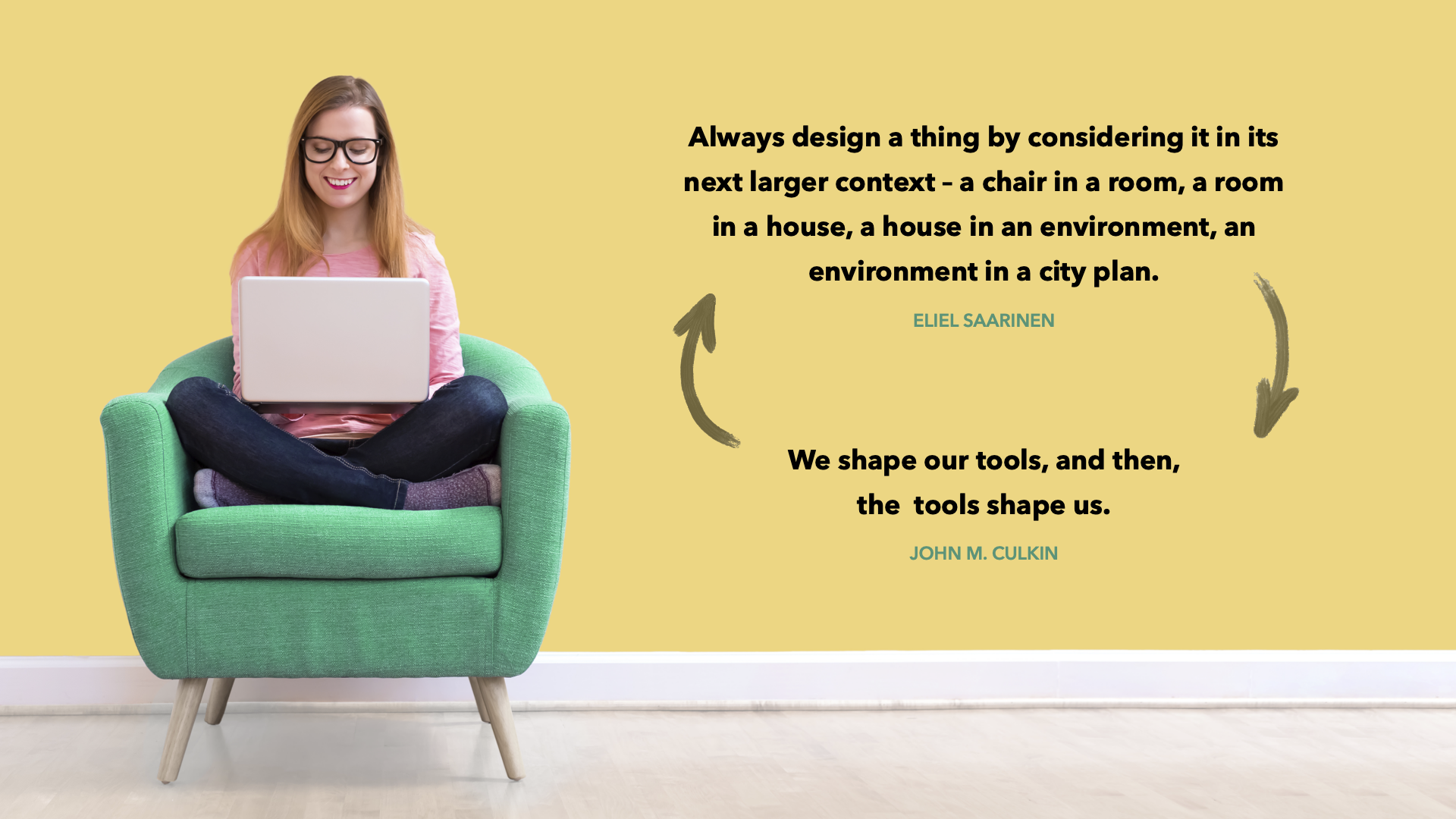
The oscillation from the room to the chair to the ass that sits there.
As information architects, our work oscillates across different scales.
Understand the site to design the platform you need. Understand the platform, and you can imagine Saarinen’s room. Understand the platform, and you can imagine the organization that uses it.

To design the room, consider the house. Design requires we work at different scales.
***
Why should we care about working at different scales? Because you’d be hard pressed to compare the information architecture of the oil giant’s platform with the IA of one of its sites. Comparing the IA of one site to another is easy.
The pre-requisite to a disciplined, systematic study of information architecture is to recognize scale changes IA in significant ways, and if we want to compare IAs, we must do so within the scale. Platform to platform. Site to site.

A platform can have many sites.
A site can have many interfaces.
An interface can have many interactions.
An organization can have many platforms.
A culture can have many organizations.
These scales assimilate the way many of our colleagues slice the world and even echo in the work of influential thinkers like Gibson.
The information architecture at each scale is affected by different forces.
One of those forces is the pace of change.
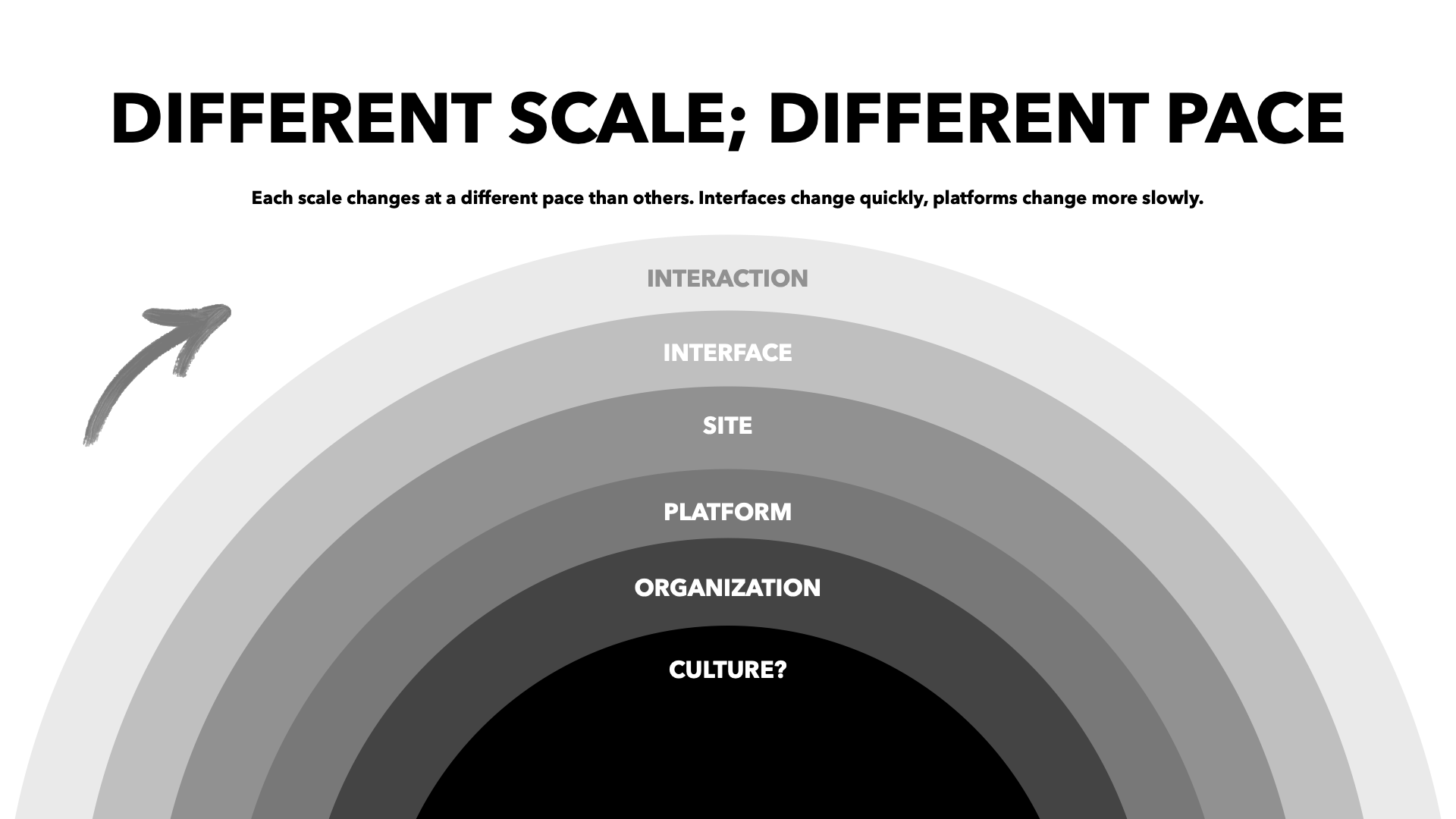
You’ve probably seen a diagram similar to this showing each level as a different pace layer. This is based on a similar diagram about buildings from Stewart Brand. That is: each layer moves at a different pace. The information architecture at each scale changes at a different pace.
In this case, the outside moves faster than the inside. You might think this works like a bike tire where the entire wheel moves in synch and everything stays aligned.
But Brand’s observation was not only that each layer moved at a different pace, but that these different paces sheared the layers away from one another. So the rotation is really more like a solar system where the planets all move at different speeds.
Although the needs and capabilities at each scale may align when you design them, the different speeds mean each layer immediately begins to shear out of alignment with the others.
Shearing means you are only aligned once, and the more and more out of alignment, the more likely the layers will shear off from one another. The information architecture at each level always exists at a different point in time. You can’t compare one scale to another because the context at the time of design and the context at time of use are always different.
The chair changes faster than the room, the room faster than the house. Sooner or later, the house, room, or chair aren’t what you need anymore.
So, to evaluate an information architecture, first identify at what scale it operates.
Information architecture generally applies to one of five scales:
The organization
The platform
The site
The interface
The interaction
At each scale, information architecture operates with different constraints. Each scale changes at different rates, and each scale operates within a different design context.
Scale gives us a way to classify the type of information architecture, so we know what we can compare. Platform to platform and site to site.